008 Using a Map Grid
👩🏫 Teacher’s Guide
Objective
Read a map and use its labels, directions, or grid to locate places.
Vocabulary
grid, cell reference, index
Suggested time
20-30 minutes, with optional practice across the week.
Teaching Notes
- Read the short passage aloud. Point to each label or number as children follow. Accept an oral answer or a labeled drawing before asking for a sentence.
- Introduce the study resource before assigning questions. Students can answer using this lesson without opening the source book.
- Use questions 1-4 for guided practice and the remaining questions for independent practice or discussion. Open responses may use different wording if the evidence supports them.
- Check the activity against its stated constraints and the answer bank. Revisit a missed concept before adding a new one.
🧒 Student Worksheet
Concept and Helping Material
A map grid divides a map into small squares. A cell reference gives a column letter and a row number. To find B2, follow column B and row 2 until they meet. An index lists names alphabetically and gives their cell references. A grid reference identifies a square, not an exact latitude and longitude.
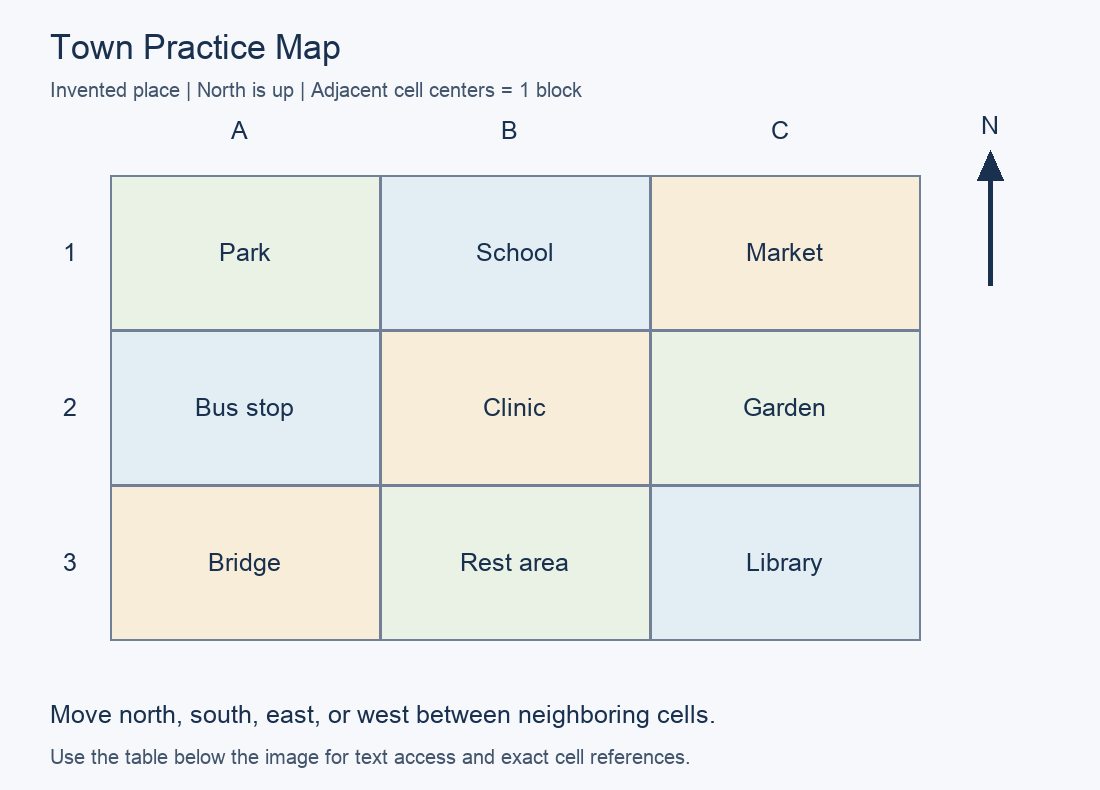
Study Resource: Town Practice Map
This is an invented practice place. North is up. Columns A, B, C run west to east. Rows 1, 2, 3 run north to south. Each cell has one place. Adjacent cell centers are one block apart. Walk only north, south, east, or west.
| Row / Column | A | B | C |
|---|---|---|---|
| 1 | Park | School | Market |
| 2 | Bus stop | Clinic | Garden |
| 3 | Bridge | Rest area | Library |
Vocabulary and Definition
- - a pattern of rows and columns
- - a label identifying a grid square
- - an alphabetical list of places and their locations
Words to Learn
, ,
Sentences to Fill In
- The term for a pattern of rows and columns is .
- The term for a label identifying a grid square is .
- The term for an alphabetical list of places and their locations is .
🧪 Think & Respond Q&A
What place is in cell A1 on the Town practice map?
What place is in cell C2 on the Town practice map?
What cell contains Clinic?
Which place is immediately east of Park?
Which place is immediately south of Clinic?
How many places are shown in row 1?
Give a two-block route from Park to Market.
How does a map index help you find a place?
On this map, is Park in the same row or the same column as Market?
What information would you need to find the real distance in meters between two places?
Which lesson word means "a pattern of rows and columns"?
Which lesson word means "a label identifying a grid square"?
Which lesson word means "an alphabetical list of places and their locations"?
Hands-On Experiment or Activities
What You Need: Paper, pencil, and nine small counters.
What You Do:
- Copy the Town practice map. Mark A1 with a counter. Ask a partner to give three legal moves and follow them. Write the start, moves, and final cell.
- Check the route by tracing each move. Then describe a different route to the same destination.
- Revise one part of your work after checking it against the lesson evidence.
Think and Talk: What evidence supports one choice in your work?
Reflection
- Which idea can you explain now?
- What would you still need to learn about a real place?
Teacher Check
Check accurate use of the study resource, correct vocabulary or units, and a reason supported by evidence. For open activities, accept more than one result when it follows the instructions. The companion CSV contains the same numbered Q&A bank shown above.
Curriculum Reference
Scope alignment: Evan-Moor, Daily Geography Practice, Grade 2, Week 8. Teacher lesson begins on printed page 34 (PDF page 36). The explanations, practice data, diagrams, activities, and questions in this lesson are original. Fictional datasets are labeled in their study resources.